On Google Ads, the Learning status lasts at most 7 days, though Google says performance takes 1 to 2 conversion cycles to settle. On Meta, an ad set leaves the learning phase after about 50 optimization events since its last significant edit, and Meta expects those within roughly a week. On TikTok, about 50 conversions is the main sign an ad group has passed learning. The clock differs, but the rule is the same everywhere: the edit you make restarts the wait. Adstudio shows which campaigns and ad sets are learning across Google and Meta, why, and which change put them there, so you can tell a campaign that is still learning from one that is not working.
TL;DR
- Google: the Learning status never lasts more than 7 days, and budget, target and creative changes do not trigger it. Evaluate a new strategy over 2 conversion cycles or 2 weeks, whichever is longer (Google Ads Help).
- Meta: about 50 optimization events since the last significant edit. Pausing an ad set or changing its optimization event, audience or creative counts as a significant edit (Meta Business Help).
- Meta's "Learning limited" means the ad set is unlikely to reach those 50 events in a week. It is not a penalty (Meta Business Help).
- TikTok: about 50 conversions to pass, and fewer than 20 in the first 10 days is an early warning (TikTok Ads Help).
- On all three, batch your edits. Each significant change starts the learning period again.
How long does the learning period last in Google Ads?
Google separates two things that marketers usually treat as one: the Learning status you see in the account, and the time it takes performance to settle.
The status is short. Google's help article on Smart Bidding learning says the Learning status marks a recent structural change, never lasts more than 7 days, and that ads keep serving normally while it shows (Google Ads Help). Google rewrote this article in October 2026 to make the 7-day limit explicit, as Search Engine Roundtable reported.
Settling takes longer. The same article says Smart Bidding performance typically converges on the new goal within 1 to 2 conversion cycles, and recommends judging a change over 2 conversion cycles or 2 weeks, whichever is longer. A conversion cycle is the time between a click and the conversion it leads to. If most of your leads convert 10 days after the click, two cycles is 20 days, well past the moment the Learning label disappears.
So the practical answer: expect the label for up to a week, and wait at least two weeks, or two conversion cycles, before you judge the result.
What puts a Google Ads campaign into learning?
Google's bid strategy status page lists the reasons you will see next to "Learning":
| Reason | What happened |
|---|---|
| New strategy | The bid strategy was just created or reactivated |
| Setting change | A setting of the bid strategy changed |
| Composition change | Campaigns, ad groups or keywords were added to or removed from the strategy |
| Goal change | The conversion goals or actions the strategy optimizes for changed significantly |
Just as useful is the list of what does not trigger it. Google's learning article says changes to budgets, targets, creatives and targeting take effect in the next auction and never trigger the Learning status (Google Ads Help). That makes a budget change the low-risk lever when you need to move spend quickly, which is the approach our Black Friday preparation guide uses for sale weeks.
Composition changes are the easy one to miss. If several campaigns share a portfolio bid strategy, adding a new campaign to it, or pausing one out of it, changes the strategy for all of them. Our guide to pausing underperforming campaigns automatically covers that side effect.
Where to check it: open the Bid strategies page from the Tools menu and look at the Status column. Hovering over the status shows the reason (Google Ads Help).
How long is the learning phase on Meta Ads?
Meta counts events, not days. An ad set needs about 50 optimization events since its last significant edit, where an optimization event is whatever the ad set optimizes for: purchases, leads, link clicks and so on. Meta suggests waiting for those 50 events before you rely on cost per result, for example before setting a cost cap (Meta Business Help).
The time it takes depends on how often that event happens. An ad set optimizing for link clicks can collect 50 quickly. One optimizing for purchases at a low budget may take weeks, and that is when Meta switches the status to Learning limited.
What is "Learning limited" on Meta and how do I fix it?
Meta shows Learning limited when an ad set is unlikely to get around 50 optimization events in the week after its last significant edit. Meta says it is not a penalty. It means the delivery system cannot optimize well with the current setup (Meta Business Help). Meta's suggested fixes:
- Raise the budget, so the ad set can buy enough results in a week.
- Widen the audience, so there are more people who can convert.
- Optimize for a more frequent event, for example add to cart instead of purchase, when purchases are too rare.
If a Learning limited ad set does reach 50 optimization events after the last significant edit, Meta moves it to Active.
Which Meta edits restart the learning phase?
Meta calls these significant edits: pausing the ad set, or changing its optimization event, audience or creative. Changes to the bid strategy or budget can count as well, depending on how large they are (Meta Business Help). Meta also suggests setting your report's date range to start at the last significant edit, so the numbers you read belong to the current setup.
That makes bulk editing on Meta a learning-phase decision as much as a time saver. If you change ten ad sets at once, ten ad sets restart. Our guide to bulk editing Meta ads shows how to make those changes in one pass instead of over several days.
How long does the learning phase last on TikTok Ads?
TikTok also counts conversions. Its learning phase FAQ says reaching 50 conversions is the most significant sign an ad group has passed the learning phase, and advises not editing a campaign before it has at least 20 conversions (TikTok Ads Help). TikTok's campaign creation FAQ adds an early warning: an ad group that struggles to get at least 20 conversions in its first 10 days has a high chance of not passing learning (TikTok Ads Help).
When an ad group is stuck, TikTok's suggestions are broader targeting, a higher bid, better creative, or an earlier optimization event such as add to cart. TikTok also warns against unreasonable budget settings while an ad group is learning, so raise budgets in steps rather than in one jump. More on running TikTok campaigns with AI is on our TikTok Ads page.
Google vs Meta vs TikTok: learning phase compared
| Google Ads | Meta Ads | TikTok Ads | |
|---|---|---|---|
| What learns | The bid strategy | The ad set | The ad group |
| How it ends | Status clears within 7 days | About 50 optimization events since the last significant edit | About 50 conversions |
| Wait before judging | 2 conversion cycles or 2 weeks, whichever is longer | Until about 50 events since the last significant edit | Until about 50 conversions; edit no earlier than 20 |
| What restarts it | New strategy, setting change, composition change, goal change | Pause, optimization event, audience or creative change; large bid or budget changes | Major edits during learning |
| Changes that do not | Budget, target, creative and targeting changes | Small bid and budget changes | Not specified by TikTok |
| Stuck status | Not applicable | Learning limited | Ad group does not pass learning |
Sources: Google Ads Help, Meta Business Help, TikTok Ads Help.
Should I make changes while a campaign is in the learning phase?
Make the changes you need, but make them together and then leave the campaign alone. Three habits cover most cases:
- Batch edits. On Meta and TikTok, every significant edit restarts the count. Five changes over five days cost five restarts; five changes in one sitting cost one.
- Use the lever that does not restart learning. On Google, budget and target changes do not trigger the Learning status, so prefer them over switching bid strategies or moving campaigns between portfolios. On Meta, small budget changes are less likely to count as significant than a new audience or creative.
- Fix tracking first. A campaign that never leaves learning is often a campaign whose conversions are not recorded. Check that before you blame the strategy: our conversion tracking checklist covers Google, and why Meta and GA4 numbers don't match covers the Meta side.
And if a Google campaign keeps underdelivering after learning, the cause may be the budget rather than the strategy. Our guide to a campaign limited by budget shows how to tell.
How do I see which campaigns are in learning across all my accounts?
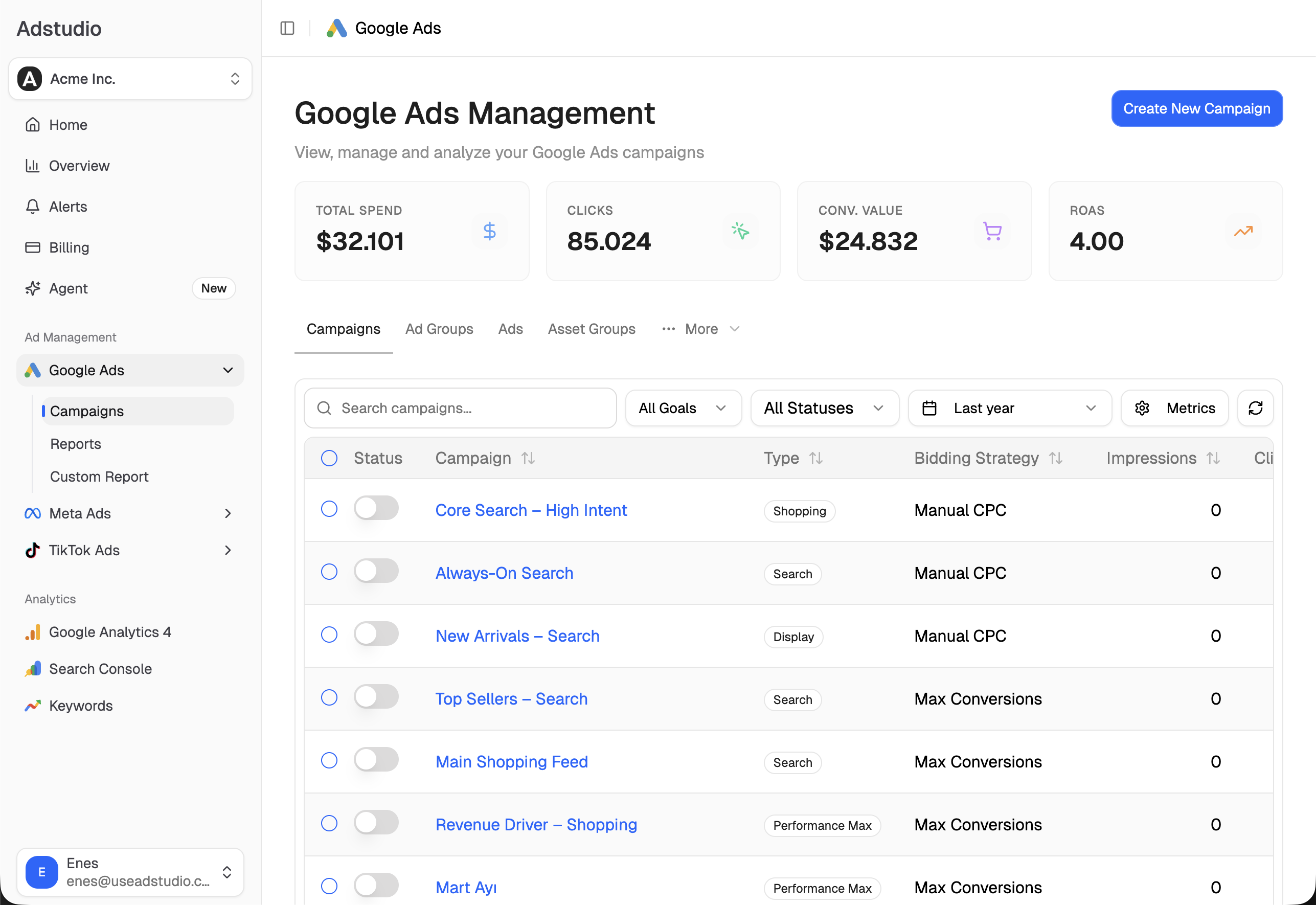
In the native tools you check this one account at a time: the Bid strategies page in Google Ads, the Delivery column in Meta Ads Manager. Adstudio reads both from your connected accounts, so you can ask once:
- "Which of my Google Ads campaigns are in learning right now, and why?" Adstudio lists each campaign with its serving status, including whether its bid strategy is learning.
- "What changed in my Brand Search campaign in the last two weeks?" Adstudio reads the Google Ads change history: what changed, who changed it, and the value before and after. That is how you find the edit that started learning.
- "Which Meta ad sets are learning or learning limited, and how many optimization events do they have?" Adstudio lists them with the optimization events so far and the date of each ad set's last significant edit, so you know how far each one has to go.
- "Raise the budget on the learning limited ad sets by 20%." Adstudio reads the current budgets from Meta, shows the exact change on an approval card, and applies it only after you confirm. When an edit you ask for restarts Meta's learning phase, such as a new performance goal or bid strategy, the card says so before you approve.
For campaigns you have just changed, a spend alert is a good companion: it tells you if spend moves sharply while the strategy relearns, without checking every day. The same review works for Meta campaigns, ad sets and ads in the same workspace; see Adstudio for Meta Ads.
FAQ
Does changing the budget reset learning in Google Ads? No. Google says budget changes take effect in the next auction and never trigger the Learning status. Bid strategy changes, conversion goal changes and adding or removing campaigns from a portfolio strategy do.
Does pausing a Meta ad set reset the learning phase? Meta lists pausing an ad set among its significant edits, alongside changes to the optimization event, audience and creative. Plan pauses with that in mind, and expect the ad set to collect its 50 optimization events again.
Why is my Meta ad set stuck in learning limited? It is unlikely to get about 50 optimization events in the week after its last significant edit. Raise the budget, widen the audience, or optimize for a more frequent event.
How many conversions does Google Ads need to leave learning? Google's current guidance is about time, not a conversion count: the Learning status never lasts more than 7 days. Performance then takes 1 to 2 conversion cycles to settle, and more conversion data helps it settle faster.
Is the learning phase bad for performance? Not by itself. Google says ads serve normally during Learning, and Meta says Learning limited is not a penalty. Results are less stable while the system adjusts, so judge them after the learning period rather than during it.
How long should I wait before judging a new campaign? On Google, 2 conversion cycles or 2 weeks, whichever is longer. On Meta, until the ad set has about 50 optimization events. On TikTok, until the ad group has about 50 conversions.
To see learning status, recent changes and performance across Google, Meta and TikTok in one place, connect your accounts to Adstudio; plans are on the pricing page.
Platform behavior described as of October 2026, per the linked Google Ads Help, Meta Business Help Center and TikTok Ads Help pages.