Can AI Actually Optimize Ad Campaigns? What Works in 2026 (and What's Hype)
TL;DR
- Demonstrably works: exhaustive account audits, wasted-spend detection, search-term hygiene (negative keywords), and budget reallocation math. Machines beat humans at anything repetitive and exhaustive.
- Mixed results: third-party bidding on top of platform AI, and creative generation — competent, not winning.
- Still hype: "set and forget" autonomous management. Every horror story traces back to AI confidently optimizing toward broken conversion data.
- The honest question isn't can AI optimize — it's which optimizations you hand over, and how much autonomy you grant when you do.
Yes — AI can genuinely optimize ad campaigns in 2026, but only for a specific class of work: the mechanical, data-heavy layer. Exhaustive audits, wasted-spend detection, search-term hygiene, and budget reallocation are demonstrably better done by AI than by a human with a spreadsheet, because they reward being tireless and exhaustive rather than clever. Results get mixed the moment AI competes with the platforms' own bidding algorithms or tries to produce winning creative, and the "set it and forget it" promise remains marketing fiction. This post separates the three tiers with as much evidence as an honest vendor can offer.
Disclosure up front: we build Adstudio, an AI marketing workspace, so we're biased — we obviously believe AI optimization works. But we also decline to ship an autonomous mode, which should tell you we don't believe all of it works. Here's the honest breakdown.
What AI demonstrably does well
These four capabilities are shipping, repeatable, and consistently better than manual work. Not because AI is smarter than a good PPC manager — because it doesn't get bored.
Exhaustive audits
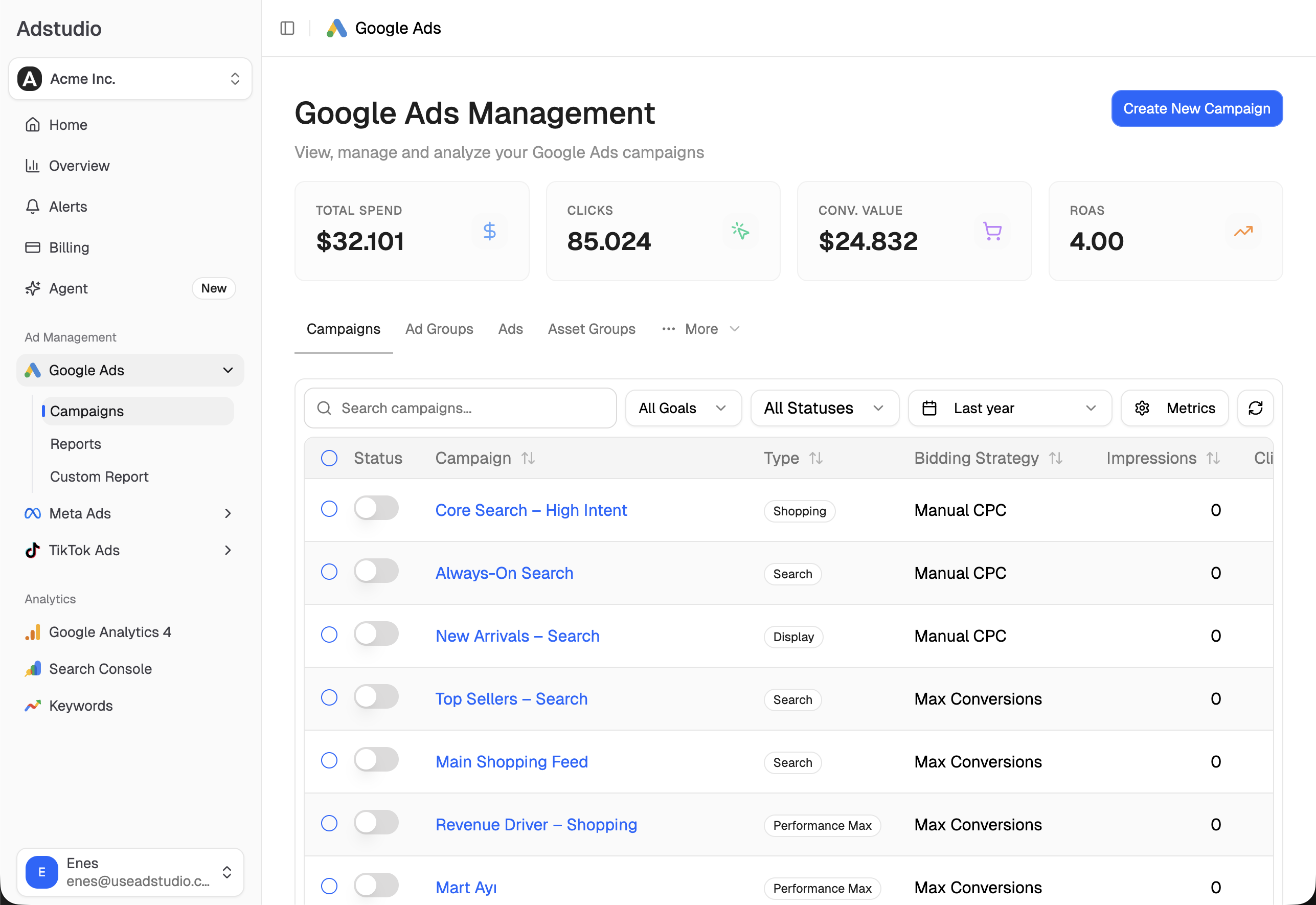
A human auditing an ad account samples: the top campaigns, the obvious keywords, whatever the client complained about. AI audits everything, every time. Adstudio's agent runs a full account audit — conversion setup, bidding strategy fit, budget-limited winners, zero-conversion spenders — in minutes on demand; tools like Adalysis run 100+ automated checks daily. The value isn't intelligence, it's coverage: the misconfigured conversion action on campaign #34 that no human review would have reached until quarter-end.
This matters more than it sounds. In our experience most "AI found a huge problem" stories aren't clever inferences — they're routine checks applied to corners of the account nobody had looked at in months.
Waste detection
Finding spend with no return is a pattern-matching problem over large datasets, which is exactly what machines are for: keywords with hundreds of clicks and zero conversions, Display placements that never convert, geo targets bleeding budget, campaigns paying for impression share on queries that can't convert. A human finds these eventually. AI finds them today, across the whole account, and can quantify the monthly bleed per item. If you adopt exactly one AI optimization capability, make it this one — it's pure downside removal with no strategy risk. (We wrote a manual playbook for it too: how to find wasted ad spend in Google Ads.)
Search-term hygiene
Negative keyword management is the canonical AI-optimizable task: high volume, clear logic, low regret. "This search term got 40 clicks, spent $180, converted zero times, and the intent is obviously wrong" is a judgment an AI makes reliably — and the fix is a reversible one-line change. Accounts that automate search-term review (via any tool, or even scripts) simply stay cleaner than accounts that do it monthly by hand, because query streams rot continuously and humans review them in batches.
Budget reallocation math
Which campaign deserves the next dollar is an arithmetic question — marginal CPA, impression share lost to budget, conversion trends — that humans answer with gut feel and AI answers with the actual numbers. "Campaign A is budget-limited at 2.1x ROAS while Campaign B spends freely at 0.6x; moving $50/day nets roughly X more conversions" is the kind of statement an AI derives in seconds and a human derives never, because the analysis is tedious. Whether the AI then moves the budget itself or asks you first is the autonomy question — more on that below.
Where results are mixed
Bidding beyond the platform AI
Here's the uncomfortable truth third-party vendors mumble past: Google's Smart Bidding and Meta's Advantage+ are extremely good at the millisecond-level auction math, because they see signals (device, audience, time, query context) that no external tool can access. A third-party AI "optimizing bids" on top of Smart Bidding is mostly adjusting targets and budgets around the platform's black box, not outbidding it.
Where external AI genuinely helps with bidding is one level up: choosing the right strategy for the campaign's data volume (Target CPA on 8 conversions a month is a known failure mode), catching when a tROAS target is strangling volume, and auditing whether the platform's automation is optimizing toward the right conversion action at all. That's auditing the machine, not replacing it — valuable, but a smaller claim than the marketing implies.
Creative
AI writes competent ad copy fast, and it's genuinely useful for filling RSA slots and generating test variants. But "competent" is the ceiling. Winning creative comes from knowing the customer's actual objection, the offer's real edge, the thing a competitor can't say — context that lives outside the ad account. AI-generated creative reliably lifts weak accounts to average; we've seen no honest evidence it takes strong accounts higher. Use it as a drafting accelerant, not a creative director.
What's still hype
"Set and forget." The pitch that you connect your account, walk away, and AI runs your ads profitably is the category's most persistent overclaim. The failure mode is well documented and structural: AI optimizes toward whatever your account reports as a conversion. If tracking double-fires, breaks during a site migration, or counts the wrong event, an autonomous optimizer doesn't get suspicious the way an experienced human does — it confidently accelerates toward the wrong number. User complaints about fully autonomous tools like Ryze AI cluster around exactly this: conversion-tracking discrepancies amplified by unsupervised execution. That's not a knock on any one product; it's the physics of autonomy plus imperfect data.
"AI replaces your marketing team." It replaces hours, not judgment. Strategy, offer, positioning, and accountability to whoever owns the budget remain stubbornly human — we made this argument at length in can AI manage Google Ads for you?.
The variable that decides your results: autonomy
The same optimization — say, pausing a zero-conversion keyword — can be delivered three ways, and the delivery mechanism matters more than the intelligence behind it:
- As a suggestion (Optmyzr, Opteo, Adalysis): safe, but you're still doing all the clicking, and suggestion queues go unread by week three.
- As a confirm-first action (Adstudio — that's us): the AI prepares the change with its reasoning, you approve, it executes. You keep the veto without doing the execution work.
- Autonomously (Ryze AI): executed 24/7 with no approval step. Maximum leverage when your tracking is airtight; maximum blast radius when it isn't.
Our deliberate weakness, stated plainly: Adstudio has no fully autonomous mode. If you want AI changing bids at 3 a.m. without asking, we're the wrong tool. We think the approval click — seconds per change — is cheap insurance against the one bad automated change a month that would cost real money. We ranked the tools across this spectrum in the best AI for Google Ads optimization.
How to actually verify it works (on your account)
Don't take any vendor's word, including ours. The evidence that matters is on your own account, and it's cheap to gather:
- Run an AI audit and fact-check it. Connect an account read-only, run an audit, and check three findings by hand. If the AI's numbers don't match the platform UI, stop there.
- Measure one month of waste findings. Total the monthly spend on the zero-conversion keywords, placements, and search terms it flags. That figure — real dollars per month — is your ROI baseline against the tool's price.
- Approve changes manually for a month. Confirm-first execution generates a paper trail: every proposed change, its reasoning, your decision. After a month you'll know exactly which change types you'd trust autonomously (negatives: probably; budgets: probably not yet).
- Only then widen autonomy — narrowly. Low-regret operations first.
Adstudio's free plan covers steps 1 and 2 indefinitely, which is deliberate: the analysis layer is where the evidence lives.
FAQ
Does AI ad optimization actually work? Yes, demonstrably, for the mechanical layer: exhaustive audits, waste detection, negative keyword hygiene, and budget reallocation math outperform manual work because they reward tirelessness, not creativity. Results are mixed for bidding beyond the platforms' own AI and for creative. "Fully hands-off management" remains overclaimed.
Can AI optimize campaigns better than a human? At exhaustive, repetitive tasks — yes, consistently: an AI reviews every search term and every placement; a human samples. At strategy, offer, and creative direction — no. The best-performing setup in 2026 is a human making judgment calls on top of AI-done operations, not either alone.
Is AI bidding better than Google's Smart Bidding? Generally no — third-party tools can't see the auction-time signals Google's own bidding uses. External AI adds value one level up: choosing the right bid strategy, catching misconfigured targets, and auditing whether the platform's automation optimizes toward the right conversion. Audit the machine; don't try to outbid it.
What's the safest AI optimization to start with? Waste detection and search-term hygiene. Both are pure downside removal — finding and cutting spend that provably doesn't convert — with reversible, low-regret changes. Budget and bid changes come later, ideally behind a confirmation step until you've calibrated trust.
Why do autonomous AI ad tools fail? Almost always because of conversion tracking, not intelligence. Autonomous AI optimizes toward whatever the account reports as a conversion; if tracking is broken or double-counting, it accelerates toward the wrong number with nobody watching. The worse your tracking, the more you need a human approval step.
How much does AI campaign optimization cost in 2026? From free to roughly $250/month, depending on how much the tool does. Analysis and audits are free on Adstudio's plan, with Adstudio Business at $39/workspace/month; autonomous tools like Ryze AI run around $40/month; professional suggestion suites like Opteo, Adalysis, and Optmyzr run roughly $129–249+/month. For most accounts, one month of detected waste covers a year of tooling.
Competitor assessments are based on public pricing, documentation, and user reviews as of August 2026 — not on live-account testing by us. Check vendor pricing pages for current numbers.