Can AI Manage Google Ads for You? What's Real in 2026 (and What Isn't)
TL;DR
- Yes, for operations: waste detection, audits, negative keywords, budget and status changes — AI handles these genuinely well in 2026.
- No, for judgment: strategy, offer, creative direction, and accountability stay human.
- The real decision isn't whether AI manages your ads — it's how much autonomy you grant: suggestions (Optmyzr, Opteo, Adalysis), confirm-first execution (Adstudio — that's us), or full autonomy (Ryze AI).
- Rule of thumb: the worse your conversion tracking and the higher your stakes, the more you want a human approval step.
Yes — AI can genuinely manage the operational layer of a Google Ads account in 2026: finding wasted spend, running audits, adding negative keywords, adjusting budgets, and pausing underperformers, all executed through the API rather than just suggested. What it cannot do is own your strategy, judge your creative, or be accountable when things go wrong. So the honest answer is "yes, but" — and the "but" is about which decisions you keep.
Disclosure: we build Adstudio, one of the AI tools in this space, so we're biased. This post isn't a listicle ranking products (we did that in the best AI to manage Google Ads) — it's the question behind the question: where's the actual line between what AI manages and what you do?
What AI can genuinely manage today
These aren't demos or roadmap promises — this is what shipping tools do on real accounts in 2026:
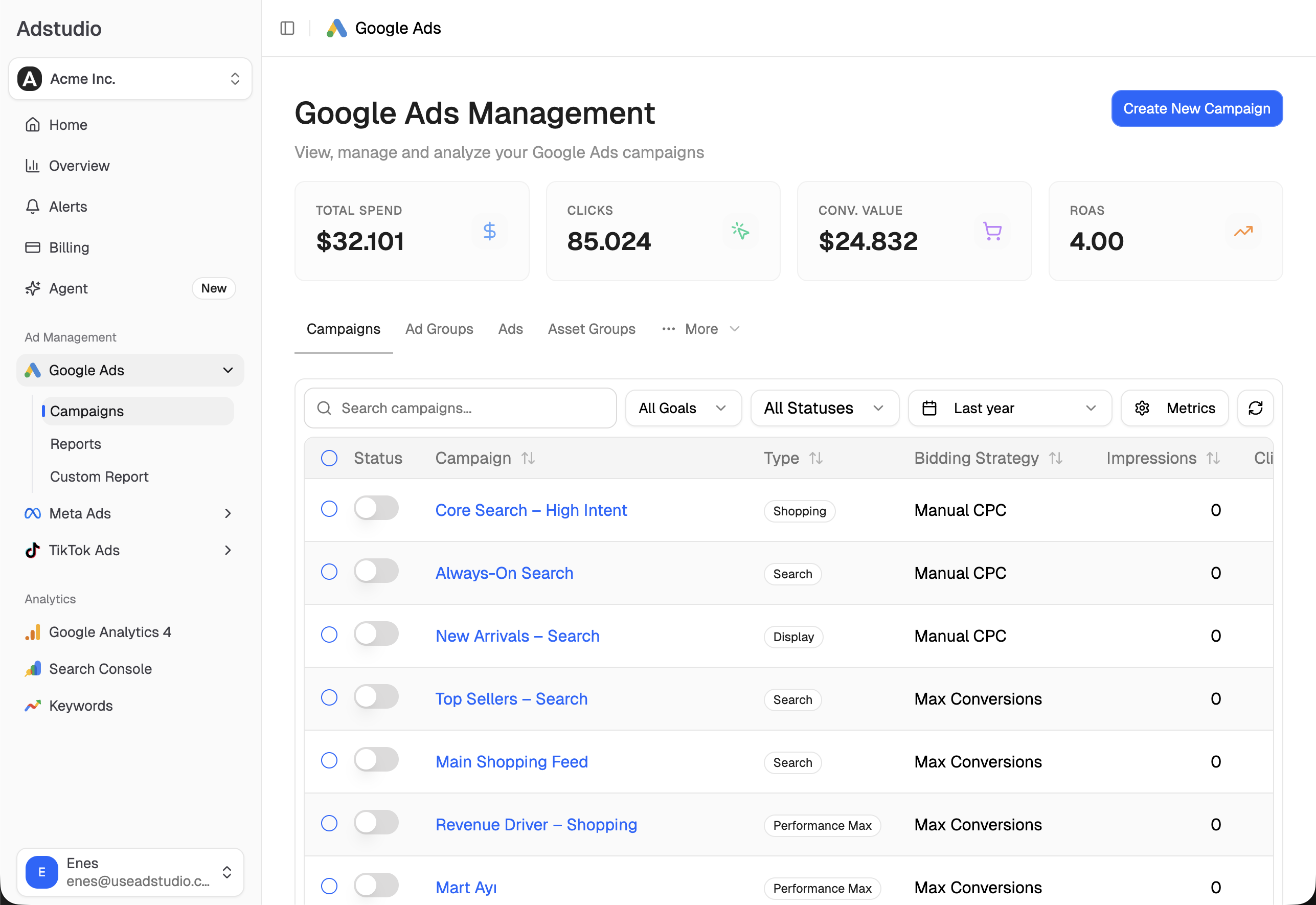
Analysis and answers. Connect an account and ask "which campaigns wasted money last month?" or "why did CPA jump last week?" — the AI queries real data and answers with numbers, not vibes. This alone replaces hours of pivot tables, and it's the least risky capability to adopt first.
Waste detection and audits. Systematic checks a human does sporadically, done daily: campaigns and keywords with spend but zero conversions, search terms bleeding budget, impression share lost to budget on profitable campaigns, Display placements that never convert, conversion tracking that quietly broke. Adstudio's agent runs a six-check account audit in minutes; Adalysis runs 100+ checks daily. The pattern is the same — machines are better at exhaustive, repetitive review than people are.
Keyword actions. Adding negative keywords from search-term analysis is the canonical AI-manageable task: high volume, clear logic ("30 clicks, zero conversions, irrelevant intent"), low regret if you can review the list. Pausing underperforming keywords and adding new ones follow the same shape.
Budget and status changes. Moving budget from a losing campaign to a winning one, pausing an ad set that's burned three days of budget with nothing to show — mechanically trivial via the API, and the AI's reasoning ("this campaign is at 3.4x your target CPA over 90 days") is inspectable before you act on it.
Reporting. Cross-platform spend summaries, client-ready custom reports, scheduled breakdowns. Fully solved; nobody should build these by hand anymore.
What AI still can't manage
Strategy. Should you enter a new market? Is brand search worth defending at this CPC? Should this quarter prioritize volume or efficiency? These decisions need context that isn't in the account: your margins, your inventory, your competitors' funding rounds, what the CEO promised the board. AI can inform them brilliantly; it can't make them.
Creative and offer judgment. AI writes competent ad copy and tests variants well. But "competent" is the ceiling — it doesn't know your customer's actual objection, and it can't tell you that your ads are fine and your offer is the problem. The highest-leverage fixes in most struggling accounts are upstream of anything the Google Ads API can touch.
Accountability. When spend doubles overnight because of a bad change, "the AI did it" satisfies no client and no CFO. Someone must be answerable, and that someone can't be a subscription. This is not a technicality — it's the reason agencies exist, and it shapes how much autonomy you should grant.
Judgment about broken data. This one's subtle: AI optimizes toward whatever your account reports as a conversion. If tracking double-counts, or broke during a site migration, the AI won't feel that something's off the way an experienced human does — it will confidently optimize toward the wrong number. Every autonomous-tool horror story we've heard traces back to this.
The autonomy spectrum
"Can AI manage my ads?" is really "how much autonomy should I grant?" There are four honest positions:
1. Suggestions only. Tools like Optmyzr, Opteo, and Adalysis analyze and recommend; a human clicks apply. Maximum control, but you're still doing all the execution work — and suggestion queues have a way of going unread by week three.
2. Confirm-first execution. The AI analyzes, decides, and prepares the change; you approve, it executes. This is where Adstudio sits, deliberately: the agent will propose "pause these 4 campaigns, add these 12 negatives, move $40/day here," and each change waits for your click. You stop doing the clicking without giving up the veto. The workflow in practice: how to manage Google Ads with an AI agent.
3. Full autonomy. Tools like Ryze AI adjust bids, budgets, and negatives 24/7 with no approval step, for around $40/month. Genuine hands-off — and genuinely less control: user complaints cluster around conversion-tracking discrepancies, which is exactly the failure mode autonomy amplifies.
4. DIY autonomy. Technical operators wire Claude or another LLM to the Google Ads API via MCP and configure exactly which operations it may run. Full flexibility; you build every guardrail yourself. See ad platform MCP servers, explained — and if you're wondering about plain ChatGPT, it can't touch your account without this plumbing.
| Approach | Example tools | You still do | Risk profile |
|---|---|---|---|
| Suggestions only | Optmyzr, Opteo, Adalysis | Every execution click | Lowest risk, highest effort |
| Confirm-first agent | Adstudio | One approval click per change | Low risk, low effort |
| Full autonomy | Ryze AI | Monitoring after the fact | Depends entirely on tracking quality |
| DIY (Claude + MCP) | Your own build | Engineering + guardrails | Whatever you build in |
When to keep a human in the loop
Grant more autonomy when the account is small, simple, and well-tracked: single platform, clean conversion data, no client to answer to, and losses from a bad week are bounded. That's where fully autonomous tools are a defensible trade.
Keep the approval step when any of these are true:
- Someone else's money or sign-off is involved — clients, a finance team, a boss who asks "why did this change?"
- Conversion tracking is anything less than airtight — or you're mid-migration.
- The account has context the API can't see — brand campaigns that look wasteful on purpose, seasonal commitments, legal-sensitive keywords.
- Spend is high enough that one bad automated week costs more than a year of tooling.
Notice the pattern: the confirm step costs seconds per change and exists for the one change a month that would have been expensive. That asymmetry is why we built Adstudio confirm-first rather than autonomous — it's also why we tell people with a $2K/month hobby account that full autonomy is honestly fine.
The practical way to start
- Start with analysis only. Connect an account, ask questions, run an audit. Zero risk, and you'll learn quickly whether the AI's reasoning holds up against what you know about the account.
- Fix tracking before granting any write access. Every level of autonomy above "suggestions" inherits your tracking quality.
- Graduate to confirm-first execution. Let the AI prepare changes; approve them for a month. You'll develop calibrated trust — and a sense of which change types you'd happily automate.
- Grant autonomy narrowly, if at all. Negative keywords first (low regret), budgets last (high regret).
Adstudio's free plan covers step 1 indefinitely, which is a deliberate choice: the analysis layer is where trust gets built. For what the agent can do end to end, see our Google Ads AI page.
FAQ
Can AI fully manage my Google Ads account? It can fully manage the operational layer — waste detection, negative keywords, budget and status changes, reporting — and tools ship this today at every autonomy level. It cannot own strategy, creative judgment, or accountability. "Fully managed" in vendor marketing means "operations automated," not "you never think about ads again."
Is it safe to let AI change my Google Ads account? With a confirmation step, yes — nothing executes without your approval, so the worst case is a bad suggestion you reject. Without one, safety depends almost entirely on your conversion tracking: autonomous AI optimizes toward whatever your account reports, including wrong numbers.
Will AI replace Google Ads managers? It's replacing the hours, not the role. The repetitive 70% of the job — audits, search-term reviews, budget shuffling, reporting — is automating fast. What's left is the part that was always the actual value: strategy, offer, creative direction, and being accountable to whoever owns the budget.
What's the difference between AI suggestions and an AI agent? Suggestion tools produce a to-do list you execute item by item — that's Optmyzr, Opteo, and Adalysis. An agent executes through the API itself — either after your approval (Adstudio) or autonomously (Ryze AI). The difference in practice is whose calendar the execution work lands on.
How much does AI Google Ads management cost in 2026? From free (analysis on Adstudio's free plan) to ~$40/month for autonomous tools like Ryze, $39/workspace/month for Adstudio Business, and ~$129–249+/month for the professional suggestion suites. Compare that to the going rate for human management — typically 10–20% of spend or $500+/month retainers — and the economics explain the category's growth.
Should I use Google's own AI instead of third-party tools? Use both, with eyes open. Smart Bidding and PMax are capable executors, but Google's AI optimizes within Google's ecosystem and will never recommend spending less. Independent AI is how you audit the platform's automation — the two jobs are complementary, not competing.
Pricing reflects publicly listed rates as of August 2026 — check vendor pricing pages for current numbers. Competitor assessments are based on public pricing, docs, and reviews, not on live-account testing by us.