The Best AI for Google Ads Optimization in 2026 (What It Actually Finds)
TL;DR
- Adstudio (that's us) — best for conversational waste detection and audits across Google + Meta, with confirm-first fixes. Free plan; $19/month solo, $39/workspace/month.
- Adalysis — audit engine: 100+ daily checks and RSA testing. From ~$149/month.
- Optmyzr — optimization suite for agencies with dedicated PPC people. From ~$209/month billed annually.
- Opteo — curated suggestion queue for hands-on Google Ads managers. From ~$129/month per account.
- Ryze AI — best if you want optimizations executed autonomously, not suggested. ~$40/month.
The best AI for Google Ads optimization in 2026 is Adstudio for conversational analysis that finds waste and fixes it with your approval, Adalysis for high-volume automated audit checks, Optmyzr for full-suite optimization at agency scale, Opteo for a prioritized one-click suggestion queue, and Ryze AI for autonomous execution of optimizations without human review. The right pick depends on whether you want a tool that finds problems, one that proposes fixes, or one that makes changes on its own.
Disclosure up front: we build Adstudio, so we're biased — here's the honest comparison anyway. The competitor assessments below come from public pricing, docs, and reviews as of mid-2026; we're not claiming to have benchmarked anyone's product on live accounts.
What AI optimization actually finds
"AI optimization" sounds abstract until you see what it surfaces in a real account. The findings are usually mundane — and that's exactly why they get missed. Typical examples:
- Search-term waste. A campaign for "project management software" quietly matching "free project management templates for students" — a few dollars a day, hundreds per month, zero pipeline. AI is good at this because it can classify thousands of search terms by intent, which no human does weekly.
- Overlapping keywords. Two ad groups bidding on near-identical terms, competing against each other and splitting quality signals. Invisible in day-to-day management, obvious in a structural audit.
- Budget-limited winners. Your best-converting campaign capped by budget while a mediocre one spends freely. The single most common finding in accounts we see — and the cheapest fix in all of PPC, because the money already exists.
- Conversion tracking drift. A tag that stopped firing after a site update, or duplicate conversions inflating results. Every optimization built on top of broken tracking makes things worse, which is why good tools check this first.
- Ads that stopped being tested. RSAs left untouched for a year while their combinations quietly underperform.
None of these require genius. They require looking, systematically, more often than humans do. That's the actual job of AI optimization — and it's the lens for the ranking below.
1. Adstudio — ask where the money went, fix it in the same conversation (ours)
Best for: teams that want optimization to be a dialogue, not a dashboard.
 Price: free plan; $19/month solo, $39/workspace/month for teams.
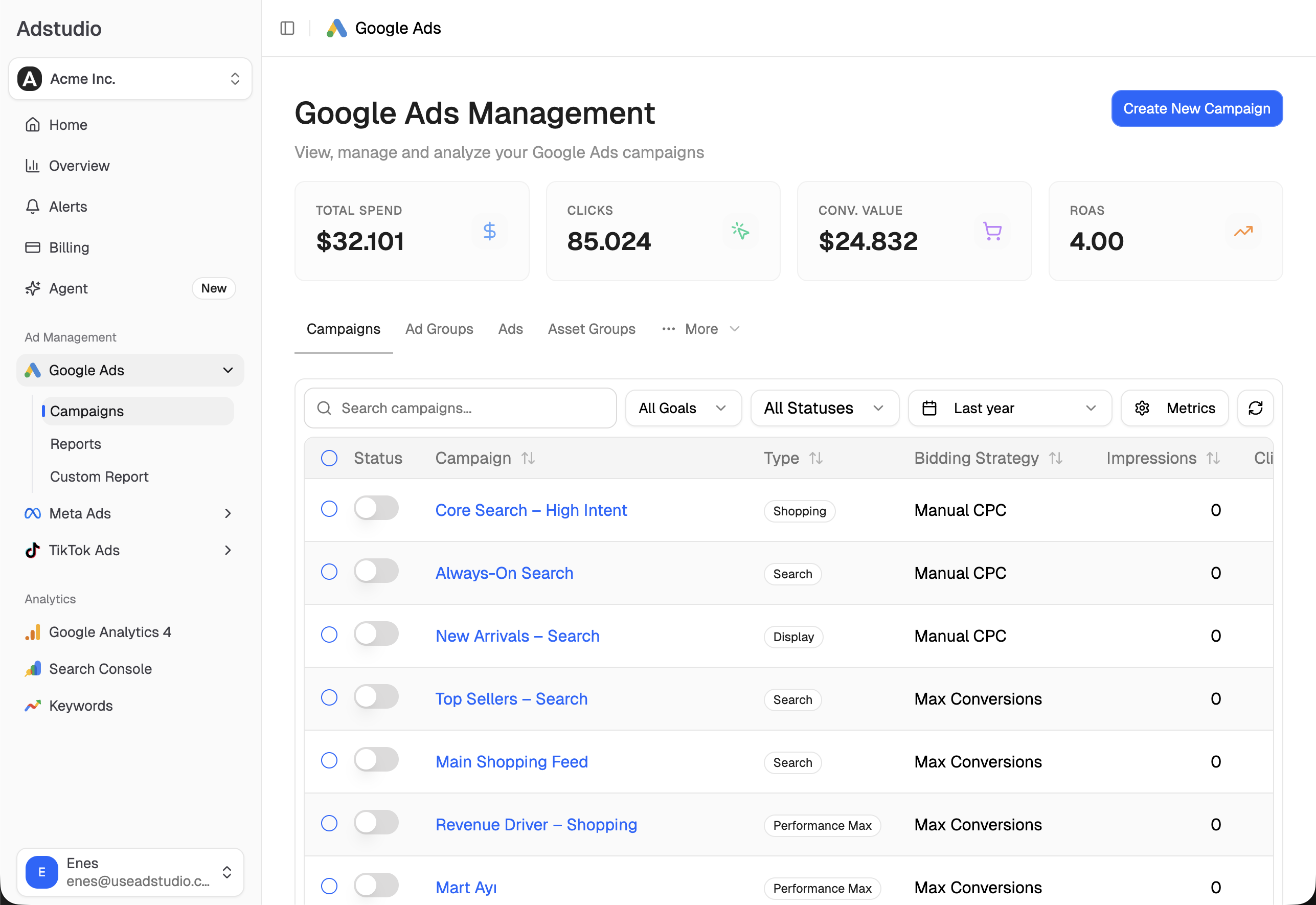
Adstudio connects an AI agent to your live Google Ads, Meta, GA4, and Search Console data. You ask "where did I waste money last month?" and it runs waste analysis, conversion-setup and bidding audits, and keyword-opportunity checks against your actual account — then proposes specific changes (pause, negatives, budget shifts) that execute only after you confirm. Because Meta lives in the same workspace, "which platform wasted more?" is answerable in one place. See how the AI agent workflow works or try it on the Google Ads AI page.
The honest weakness: no autonomous mode — everything is confirm-first, by design — so it won't optimize while you're offline. It's a newer product without a decade of accumulated audit checks, and there's no Microsoft Ads support. Specialists who want 100+ scheduled structural checks running daily will find Adalysis more exhaustive.
2. Adalysis — daily audit checks at volume
Best for: PPC specialists who want a daily, ranked to-do list from their account data. Price: from ~$149/month up to $50K monthly spend; ~$249/month up to $150K.
Adalysis audits your account daily against 100+ checks — quality score movement, ad strength, n-gram waste, landing page issues — and ranks findings by urgency. Its RSA testing engine is a dedicated continuous ad-testing tool. If "optimization" to you means never missing a structural problem, Adalysis is built for exactly that.
The honest weakness: Google and Microsoft only, and it's a finder more than a fixer — you still do the work in the interface. There's no cross-platform story, no conversational layer, and the UI shows its age in places.
3. Optmyzr — optimization suite for professionals
Best for: agencies and in-house teams with a dedicated PPC owner and serious spend. Price: from ~$209–249/month billed annually, scaling with spend and accounts to $499+.
Optmyzr wraps audits, one-click optimizations, budget pacing, and a deep Rule Engine into one suite, across many accounts at once. For an agency optimizing 30 clients, the multi-account breadth is the draw. The one-click optimizations are curated and practical.
The honest weakness: the learning curve is real (weeks, not hours) and the price assumes you're a professional. Teams that use 10% of it feel that in the invoice — the pattern that prompted our Optmyzr alternatives post.
4. Opteo — a well-curated suggestion queue
Best for: hands-on managers who want findings prioritized, one click from applied. Price: from ~$129–149/month, per linked account.
Opteo continuously monitors your Google Ads account and surfaces improvements in priority order — each one applicable with a single click. It occupies a middle spot: more actionable than a raw audit report, more controlled than autonomy. Budget and anomaly alerts round it out.
The honest weakness: Google Ads only, per-account pricing that stacks up for agencies, and the analysis stops at Opteo's predefined check types — you can't ask it an open question about your account.
5. Ryze AI — optimization as a service, no questions asked
Best for: accounts nobody has time to optimize at all. Price: around $40/month for the core plan; tiers from $10/week to ~$89/month Pro.
Ryze doesn't suggest optimizations — it makes them: bids, budgets, negative keywords, continuously and autonomously across Google and Meta. For a neglected account, that beats no optimization by a wide margin, at a price traditional suites can't touch.
The honest weakness: you can't review what you can't see coming. Autonomy means less transparency into individual decisions, and public reviews include reports of conversion-tracking discrepancies — a serious concern when the system optimizes toward those conversions unsupervised. Trustpilot sits around 4.3 on a small review count; promising, not yet proven at scale.
Comparison at a glance
| Tool | Best for | Starting price | Platforms | AI type |
|---|---|---|---|---|
| Adstudio | Conversational waste detection + confirm-first fixes | Free; $19/mo solo | Google, Meta, GA4, TikTok (reporting), Search Console | Confirm-first agent |
| Adalysis | Deepest daily audits + RSA testing | ~$149/mo | Google, Microsoft | Suggestions (audit-driven) |
| Optmyzr | Agency-scale optimization suite | ~$209/mo (annual) | Google, Microsoft, Amazon | Suggestions + rules |
| Opteo | Prioritized one-click improvements | ~$129/mo per account | Google only | Suggestions |
| Ryze AI | Autonomous optimization | ~$40/mo | Google, Meta | Autonomous |
How to choose
Ask what's actually broken in your process. If problems go unnoticed, you need audit depth — Adalysis, or Adstudio if your spend spans platforms. If problems are noticed but unfixed, you need execution — Opteo's one-click, Optmyzr's rules, Adstudio's confirm-first agent, or Ryze's autonomy, in ascending order of trust required. If nobody looks at the account at all, Ryze or a strong alert setup beats any suggestion tool, because suggestions nobody reads optimize nothing. And if your spend spans more than Google, Adstudio's free plan is the widest-fit place to start — the analysis layer costs nothing to run. For the broader tool landscape beyond optimization, see our Google Ads management tools comparison.
FAQ
Can AI really optimize Google Ads better than a human? At scanning, yes: classifying 10,000 search terms by intent or checking 100 structural rules daily is machine work, and humans simply don't do it consistently. At judgment — whether a campaign should exist, what a lead is worth — humans still win. The best setups pair AI detection with human decisions, which is why confirm-first tools exist.
What does AI find in a Google Ads account audit? Most commonly: search-term waste (irrelevant queries quietly matching your keywords), overlapping keywords competing across ad groups, budget-limited campaigns that convert well while weaker ones spend freely, broken or duplicate conversion tracking, and stale ads nobody has tested in months. Individually small, collectively often 10–20% of spend.
Is Adalysis or Optmyzr better for optimization? Different jobs. Adalysis if audits are the point — its 100+ daily checks and RSA testing are narrower but deeper, at a lower price (~$149 vs ~$209+/month). Optmyzr if you need the full suite: rules, budget pacing, multi-account tooling. Some specialist teams run both.
Should I let AI make optimization changes automatically? Depends on the change. Negative keywords and pausing proven losers are low-risk to automate. Budget moves and bid strategy changes deserve review — a tracking glitch can send an autonomous optimizer confidently in the wrong direction. Confirm-before-action is the middle ground: AI does the finding and the clicking, you do the approving.
How much does AI Google Ads optimization software cost in 2026? From ~$40/month (Ryze) through $19–39/month (Adstudio — pricing here), ~$129/month per account (Opteo), ~$149/month (Adalysis), to ~$209+/month (Optmyzr). Keep tooling under 2–3% of monthly ad spend as a sanity check.
Can ChatGPT optimize my Google Ads? It can reason about data you paste in, but it can't see your account, track changes, or execute anything — and the copy-paste loop breaks down fast. We tested the boundaries in can ChatGPT manage your Google Ads.
Pricing reflects publicly listed rates as of August 2026 — check each vendor's pricing page for current numbers.