The Best AI Agents for Google Ads in 2026 (Tools That Act, Not Just Report)
TL;DR
- Adstudio — confirm-first agent: analyzes, proposes, executes after your approval, across Google + Meta + GA4. Free plan; from $19/month.
- Ryze AI — fully autonomous agent: bids, budgets, negative keywords 24/7 with no approval step. Around $40/month.
- Claude + MCP (DIY) — build your own agent over the Google Ads API. Free-ish beyond the AI subscription, but you're the engineer and the safety layer.
- Google's own AI (PMax, auto-apply recommendations) — free platform AI, but it optimizes for Google's goals with your budget.
The best AI agents for Google Ads in 2026 are Adstudio if you want an agent that executes changes with a human approval step, Ryze AI if you want fully autonomous 24/7 execution and trust your conversion tracking completely, and the Claude + MCP DIY route if you're technical and want to build your own. Google's built-in AI (Performance Max, auto-applied recommendations) is the fourth option everyone already has — and the one with the clearest conflict of interest. The defining question isn't which AI is smartest; it's who approves the change before it spends your money.
Disclosure first: we build Adstudio, so we're biased. We'll be honest anyway — including about what our own agent deliberately refuses to do. Competitor assessments are based on public pricing, docs, and user reviews rather than us running their tools on live client accounts.
What makes something an "agent" (and not a dashboard)
Most "AI for Google Ads" tools are analysis layers: they find problems and hand you a list. Useful — we compared that whole field in the best AI to manage Google Ads — but they don't act. An agent, by our definition, must do three things:
- Read your real account data, not screenshots you paste in.
- Decide what to change, with reasoning you can inspect.
- Execute the change through the API — pause the campaign, add the negative, move the budget.
By that bar, the field in 2026 is surprisingly small. Here are the four real options.
1. Adstudio — the confirm-first agent (ours)
Best for: teams that want an agent doing the operational work while a human keeps sign-off.
Adstudio's agent is Claude-based with 36 tools over your connected accounts: a six-check account audit, waste detection, keyword and search-term actions, budget and status changes, ad copy updates, even campaign creation. The workflow is deliberate: the agent analyzes, shows its reasoning, and presents each change as a proposal card — you confirm or reject before anything touches the account. It's also cross-platform in one workspace: Google, Meta, GA4, Search Console, ChatGPT Ads, plus TikTok reporting. There's a free plan, Hobby at $19/month for solo marketers, and Business at $39/workspace/month.
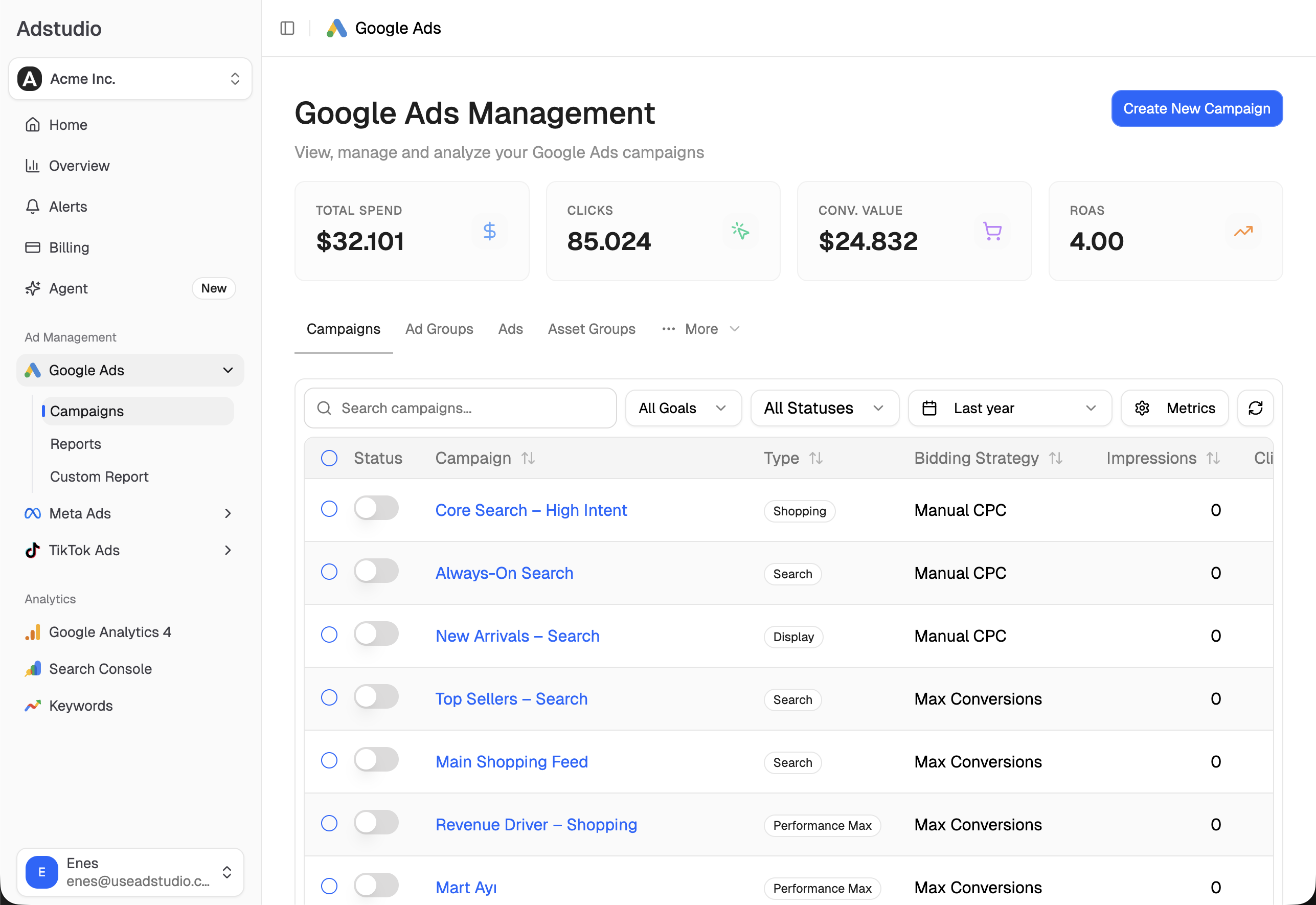
The honest weakness: there's no autonomous mode. Every change waits for a click from you — that's the product philosophy, not a missing feature, but if you want zero involvement, this isn't zero involvement. It's also a newer product than the incumbents, and Microsoft Ads isn't covered. Full capability rundown on our Google Ads AI page; the day-to-day workflow is in how to manage Google Ads with an AI agent.
2. Ryze AI — the autonomous agent
Best for: small advertisers who want a true "set and forget" and accept less control.
Ryze AI (get-ryze.ai) is the purest autonomous play: it manages bids, budgets, and negative keywords across Google and Meta around the clock, no approval step. Pricing is around $40/month flat for the core tier as of mid-2026 (tiers run from about $10/week to an $89/month Pro), and its Trustpilot sits around 4.3 on a small review count.
The honest weakness: autonomy without a checkpoint means the agent's mistakes execute at machine speed. The recurring user complaint is conversion-tracking discrepancies — and an autonomous agent optimizing on mis-tracked conversions is confidently steering toward the wrong target. Transparency is also thinner: you see that changes happened more than why. If you go this route, audit your conversion tracking first.
3. Claude + MCP — the DIY agent
Best for: technical marketers and engineers who want full control and don't mind owning the plumbing.
The Model Context Protocol lets you wire Claude (or another LLM) directly to the Google Ads API: the model gets tools to query campaigns, pull search terms, and — if you grant them — mutate the account. It's powerful, effectively free beyond your AI subscription and API access, and completely yours. We explain how the pieces fit in ad platform MCP servers, explained.
The honest weakness: you are the engineer, the security team, and the safety layer. You'll handle OAuth and developer tokens, decide which write operations the model may call, and build your own approval flow — or run with none, which is how a hallucinated campaign ID becomes a real paused campaign. It's a solid learning path and a real option for solo technical operators; it's not something to hand a marketing team. (A related question we get constantly: can ChatGPT manage your Google Ads? — short answer, not without exactly this kind of plumbing.)
4. Google's own AI — the platform agent you already have
Best for: everyone, as a baseline — with supervision.
Smart Bidding, Performance Max, and auto-applied recommendations are agents by any reasonable definition: they read data, decide, and execute, autonomously and for free. And they're good at what they do.
The honest weakness: the principal-agent problem is built in. Google's AI optimizes within Google's ecosystem toward targets that correlate with — but aren't identical to — your profit. It will never recommend spending less, never flags brand-term cannibalization, and PMax's reporting is famously opaque about where money actually went. Auto-apply recommendations in particular deserve a hard look: many practitioners disable most of them. Use Google's AI as the execution layer, and something independent as the audit layer — that's the gap third-party tools exist to fill (see best Google Ads management tools in 2026 for the wider field).
Comparison at a glance
| Agent | Best for | Starting price (mid-2026) | Platforms | AI type |
|---|---|---|---|---|
| Adstudio | Teams wanting execution + human sign-off | Free plan; from $19/mo | Google, Meta, GA4, Search Console, ChatGPT Ads, TikTok (reporting) | Confirm-first agent |
| Ryze AI | Hands-off small advertisers | ~$40/mo | Google, Meta | Fully autonomous |
| Claude + MCP (DIY) | Technical operators | AI subscription + your time | Whatever you wire up | As autonomous as you configure |
| Google's own AI (PMax, auto-apply) | Everyone, supervised | Free | Google only | Autonomous, Google's objectives |
The autonomy question, honestly
The industry is racing toward "fully autonomous," and we think that's the wrong default for most accounts. Not because the AI isn't capable — because accounts have context the API doesn't carry: the client who must approve budget moves, the brand campaign that looks wasteful but exists for a reason, the tracking migration mid-flight. A confirm step costs you seconds per change and catches the one change per month that would have been expensive. We wrote up the full spectrum in can AI manage Google Ads for you?
If your account is small, simple, and well-tracked, autonomy's downside is bounded — Ryze is a fair pick. As stakes and complexity rise, the approval step earns its keep. That's the bet Adstudio makes — and the free plan is the low-risk way to test it.
FAQ
What is an AI agent for Google Ads? A tool where AI doesn't just analyze your account but executes changes through the Google Ads API — pausing campaigns, adjusting budgets, adding negative keywords. That's the line between an agent (Adstudio, Ryze AI, a DIY Claude + MCP setup) and a suggestion tool (Optmyzr, Opteo, Adalysis), where a human still does every click.
Are AI agents safe to let loose on a Google Ads account? Confirm-first agents are safe by construction — nothing executes without approval. Autonomous agents are as safe as your conversion tracking and your tolerance for unexplained changes; audit tracking before granting autonomy. DIY agents are exactly as safe as the guardrails you build.
Can I build my own Google Ads AI agent with Claude and MCP? Yes, and it works: MCP servers can expose Google Ads API operations as tools the model calls. You'll need developer tokens, OAuth setup, and your own approval logic. See ad platform MCP servers, explained for how the pieces fit.
Is Performance Max an AI agent? Functionally yes — it reads data, decides, and executes autonomously. The catch is whose objectives it serves: Google's AI optimizes within Google's ecosystem and will never tell you to spend less. Treat it as an execution layer that needs an independent audit layer on top.
What's the difference between Adstudio and Ryze AI? Both are agents that execute real changes on Google and Meta. Ryze acts autonomously, 24/7, without approval (~$40/month). Adstudio deliberately requires confirmation on every change and adds cross-platform reporting with GA4 and Search Console in the same workspace (free plan; $39/workspace/month). Pick based on how much control you want to keep.
Pricing reflects publicly listed rates as of August 2026 — check vendor pricing pages for current numbers. Competitor assessments are based on public pricing, docs, and reviews, not on live-account testing by us.